Learn to see it · the mechanics, one at a time
The whole read is built on one shape. Get this one in your eye and most of the page stops being jargon. So before any rule or threshold, we are going to just look at one, then take it apart slowly, then teach you the single question that separates the real ones from the traps. No prior knowledge assumed. Take your time.
First, just look
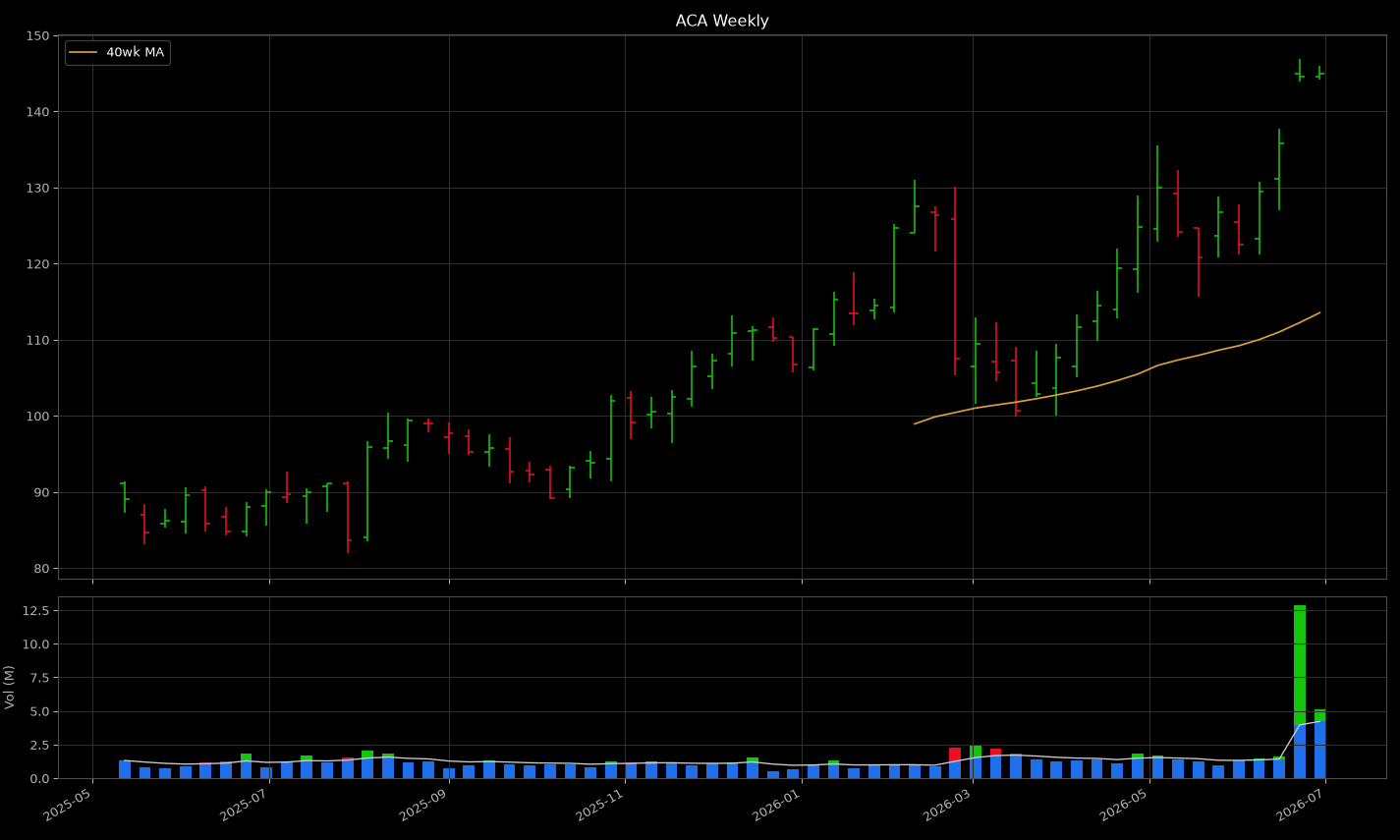
Do not read anything into it yet. Just notice the right edge of the chart: the stock ran up for months, and then, up near the top, it went quiet. The bars got shorter. The range tightened. It stopped making big moves and started drawing itself into a small, calm knot right under its own ceiling.
That calm knot near the high is the coil. That is the whole shape. A stock that ran, then paused, and is now coiled tight against the roof like a spring that has not let go yet.
What is happening underneath
Here is the thing to feel, because the mechanic matters more than the picture. A stock runs because buyers are willing to pay up. It cannot run forever in a straight line. At some point sellers show up at the high and say, not higher than this, not yet.
Now you have a standoff. Buyers will not let it fall far, because they still want it. Sellers will not let it rise, because they are handing out shares at the top. Neither side wins, so the range gets narrower and narrower. That narrowing is the coil. It is tension, held in plain sight.
And that is why it is worth watching: a coil is unresolved. It is a pause pressed right against the ceiling, and it is going to break one way or the other. The coil is not the answer. It is the question, framed. Our job on the read is to find the questions worth standing near, and then read which way the tension is leaning.
Hold this
A coil is a stock that ran, then paused tight against its high while buyers and sellers fight to a standstill. The tighter and higher the pause, the more loaded the spring.
The four things that make it real
"Looks tight to me" is not a coil. The machine will not act on a feeling, so it puts a ruler on every one of the 1,590 names and keeps only the ones that pass four plain tests. Read these with the ACA chart above still in your mind. Every number here is the real one the engine runs on, printed in full on the how we count page.
1. The box is genuinely tight. Take the longest run of 3 to 12 recent weeks whose entire high-to-low range fits inside 4.0 ATR. ATR is just the stock's own normal weekly swing, so "tight" is measured in each name's native units. A 4-ATR box means the same thing on a sleepy insurer and a wild small-cap. If the range will not fit in the box, it is not coiling, it is just drifting.
2. It is pressed to the high. The close has to sit within 8% of the 52-week high. A tight range in the middle of nowhere is not the pattern. We only care about the quiet that happens right under the ceiling, because that is where a breakout has somewhere to go.
3. It has not already run. If the close is more than 8 ATR above its 40-week average, it is thrown out as extended. That is the move everybody already sees. We are hunting the coil before it is obvious, not chasing it after.
4. The spring is at its tightest. A name graduates from coiling to an act-ready setup when this week's bar is an inside bar (a higher low and a lower high than the week before, the last little compression) sitting in the upper 40% of the box. That is the spring wound as far as it goes, cocked at the top of its range.
The one question that matters most
Here is where most people get hurt, and here is the entire reason this site exists. Two stocks can draw the exact same coil on price. Same tight box, same press to the high, same cocked spring. On the price chart alone you cannot tell them apart. One is a real pause before a move up. The other is a quiet exit dressed up to look like a pause.
The tell is not in the price. It is in the volume underneath. Look at the bottom panel now. The white line is the stock's normal volume. The part of a bar that pokes above that line is the cap, the extra effort that only appears when big money is actually moving. Green cap means that push happened on an up week. Red cap means it happened on a down week. That color is who is really in the box.
Same coil you already looked at. Now watch the volume.
Look at that last volume bar: a big green cap, far above the white line, on an up week. That is heavy buying pouring in while the stock sits quiet at the high. Institutions are accumulating into the pause. Structure says coil, commitment agrees. The read calls this cohering: 6G / 0R, six green caps to zero red. The roof is being validated by the people who move size.
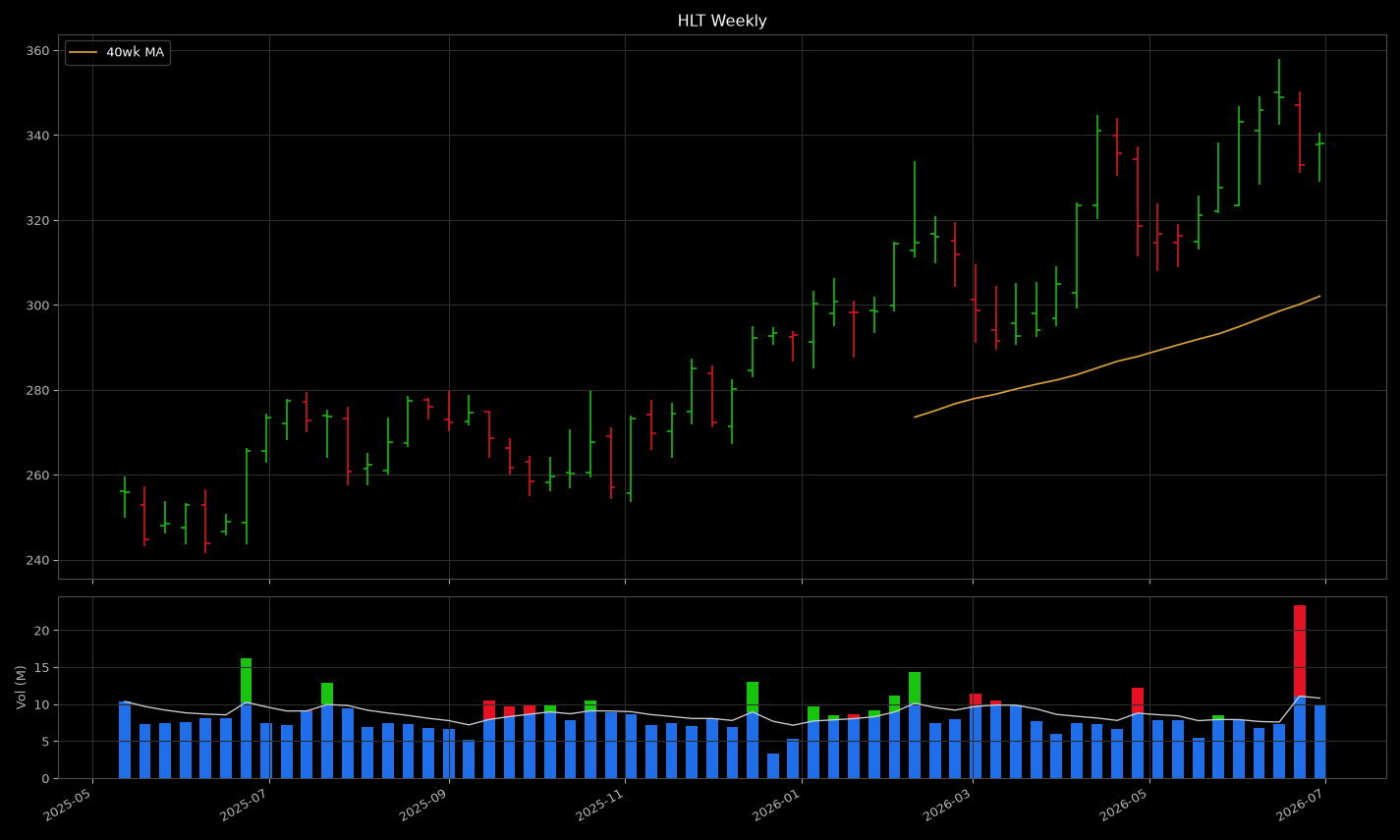
Nearly the same picture on price. One thing is different.
Same tight coil near the high. But the biggest cap under it is red, a wall of volume on a down week. That is supply leaving quietly while the price hovers and looks calm. The costume is a coil, the body underneath is an exit. The read calls this diverging: 1G / 2R. This name goes on the front page too, with equal billing as a fake. Counting the traps out loud is the whole point.
The question, every time
Same coil on price. Look under it. Are the loudest caps green or red? Green is buying into the pause. Red is selling into it. That one look is the difference between a setup and a trap.
Now go find one yourself
Open today's read. Everything under the coil headings now has a handle you can hold. Pick any name and run the two questions in order, out loud if it helps:
One: is this a real box at the high? Tight range, close within 8% of the top, not already run out to the moon. If yes, it is a genuine coil and worth your attention.
Two: look under it. Are the loud caps green or red? Green and it is cohering, a pause with buyers behind it. Red and it is diverging, a pause with an exit behind it. The read has already sorted them into those two piles for you. Now you can check its work instead of trusting it.
That is the skill. Not memorizing a call, but seeing the mechanic yourself, so the next time a chart goes quiet near its high you already know which question to ask. Do it on ten names and it stops being a definition and starts being something you can see across the room.